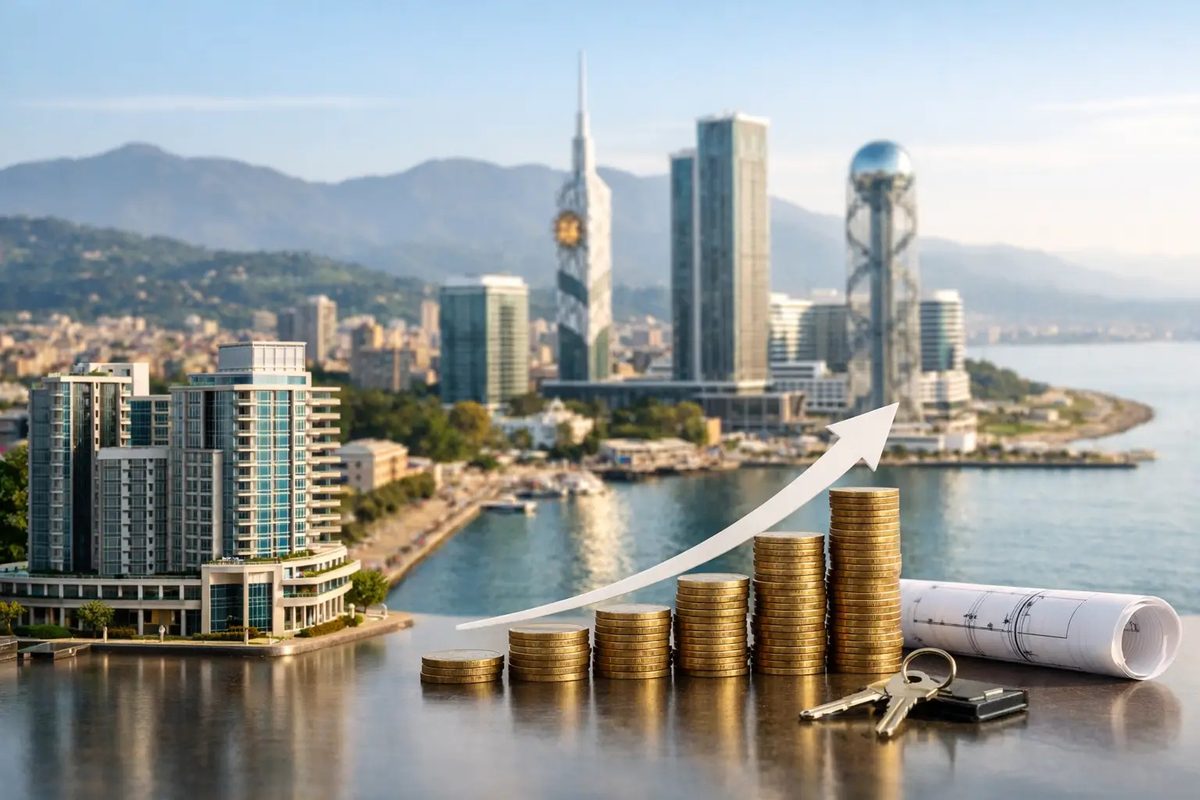
Anyone who examines the increase in the value of real estate in Batumi today does not only ask if prices are rising. The right question is why they are rising, in what areas, in what type of property, and what differentiates between speculative buying and investment based on real demand. In Batumi, this difference is critical. A fast-growing market can create great opportunities, but also confuse investors who only look at the price tag.
The increase in the value of real estate in Batumi does not happen by accident
Batumi is not the story of one city that happened to be on the investor map. This is a market that is fed by several engines at the same time - tourism, urban development, improving infrastructure, the entry of foreign capital, and entry prices that are still considered relatively accessible to other markets. When all of these work together, a basis for appreciation is created, not only as a marketing headline but as an understandable economic process.
The first component is the tourist traffic. Properties in tourism demand centers benefit not only from ongoing income from short-term rentals, but also from higher demand from future buyers. An investor doesn't just buy an apartment - he buys a location that is capable of generating real use. The more traffic, more hotels, more restaurants, and more services the area gets, the stronger the value of real estate becomes.
The second component is continuous development. In cities where there is a boom in construction, improvement of promenades, roads, entertainment centers, and new projects, the price is not determined only by the current situation. It is also influenced by the expectation of what the region will be in three to seven years. In Batumi, this is especially noticeable in major tourist areas where the urban upgrade attracts both tourists and investors.
What Really Pushes Prices Up
There is a tendency to attribute price increases only to "demand," but in an investment market, it is right to break it down into more measurable factors. In Batumi, one of the most significant factors is the pricing gap compared to other markets. For an Israeli investor, the entry point is still relatively low. When the entry price is low, the circle of potential investors is wider, and this in itself supports demand.
In addition, there is a strong influence on the type of product. Not every property enjoys the same increase in value. A standard apartment in a weak area will not behave like a premium property in the heart of a tourist area with a high standard of hospitality. Investors who only look at the price per square meter sometimes miss what is really important - the quality of the location, suitability for short-term rentals, the visibility of the property, and the ability of the management company to maintain occupancy and a high level of product over time.
This is exactly where the question of management comes in. An asset that is not well maintained wears out faster - both in income and value. On the other hand, apartments that are managed to a hotel standard, with regular maintenance, proper design, and a good hospitality experience, better maintain their attractiveness. In a tourism market, this is not a small operational detail. This is a direct part of the ability to generate future value.
Where Real Estate Value Rise in Batumi Tends to Be Stronger
The simple rule is that location comes first, but Batumi needs to be more precise. It is not enough to be "in the city". There is great significance to the proximity to the promenade, entertainment centers, the beach, major traffic arteries and areas with consistent tourist traffic. The more the property is located in an area that actually serves tourists, the stronger it has for both ongoing yield and value appreciation.
In key areas, demand relies on real use. Tourists want to be close to what they came for, and future investors are looking for properties that have already proven performance. This is different from peripheral areas that rely mainly on promises for the future. This does not mean that it is impossible to make a profit there as well, but the risk profile is different, and the timetable for appreciation may also be longer.
Therefore, a serious investor is not satisfied with the question of whether the project is new. He checks whether the location will continue to be relevant in a few years, whether there is a tourist infrastructure around it, and whether the property is suitable for the paying audience. Appreciation occurs faster where money is already flowing, not just where it is hoped it will come.
The difference between appreciation on paper and appreciation that can be realized
One of the most common mistakes in overseas investments is confusion between an asking price and a value that can be realized in a sale. An investor can see an increase in marketing prices and feel that his property is "worth more", but the important question is whether there is an active buyer market at the same price. A real increase in value is one that has liquidity - that is, the ability to sell on reasonable terms without getting stuck for many months.
For this to happen, the property needs to speak to two audiences at the same time. On the one hand, it needs to work well as a short-term rental and generate cash flow. On the other hand, it should be a product that looks good to the next investor as well. If the furniture is weak, the location is mediocre, or the maintenance is inconsistent, the potential in the sale is compromised.
Therefore, when looking at appreciation, you also need to look at the exit strategy on the day of entry. Who might buy the property in the future, why would they want it, and what would make them pay a premium. These are far more important questions than a general promise that "the city is developing."
What are the risks to consider?
A growing market is not a risk-free market. In Batumi, as in any investment destination, the timing of the purchase, the quality of the project, the level of competition in the region and the management after the purchase are significant. If you enter the wrong property, even a strong market will not always compensate for the choice.
The first risk is to buy a property just because it's cheap. A low price can seem tempting, but if it comes with a weak location, a low-end building, or a product that isn't suitable for a tourist guest, appreciation may be limited. The second risk is to rely on yield without understanding the operation. In Batumi, the value of a property is directly related to its ability to actually work as an income-producing asset.
There's also the issue of supply. When you build a lot of projects, not everyone wins. Those who benefit more from appreciation are usually those who own a property that stands out from the market - better in location, better at the finish level, and better in management. In a competitive market, mediocrity erodes quickly.
How an Israeli Investor Should Examine the Potential
An Israeli investor looking for a property in Batumi should not look for the cheapest apartment, but the best deal. That means looking at three things together - price of entry, revenue potential, and future sales potential. If one of them is weak, the picture is partial.
It is also worth examining the investment against alternatives. If an entry price of about $40,000 to $45,000 allows entry into a managed hospitality property in a sought-after area, it creates an interesting starting point in relation to markets where much higher capital is required. But here, too, the result depends on the choice of the property and its operation. A well-managed property can combine current income with appreciation. An inaccurate property may be left behind.
This is why many investors prefer a model that covers not only the acquisition but also the management, maintenance, collection, and preparation for a future sale. When there is a single entity that connects all the stages of the investment, it is easier to maintain the quality of the asset over time and maximize the chance of creating value. This is precisely the logic that guides MyBatumi's activity vis-à-vis investors who seek to invest abroad without becoming asset managers remotely.
So is Batumi still interesting for appreciation?
Yes, but not as a shelf deal. The increase in the value of real estate in Batumi can still be a significant component of an investment decision, especially when combined with the potential for short-term rentals. However, this potential is not equally divided among all assets. He is more focused on the right assets, in the right areas, and in a management framework that knows how to maintain a standard and sell a clear investment story to the next buyer as well.
Anyone who approaches this market professionally, with an examination of real demand and not just a beautiful presentation, can find in Batumi a relatively rare combination of an accessible entry price, an active tourism market and a realistic possibility for improvement. In the end, it is not the low price that creates the good deal - but the ability to buy a property that knows how to work today and be in demand tomorrow as well.