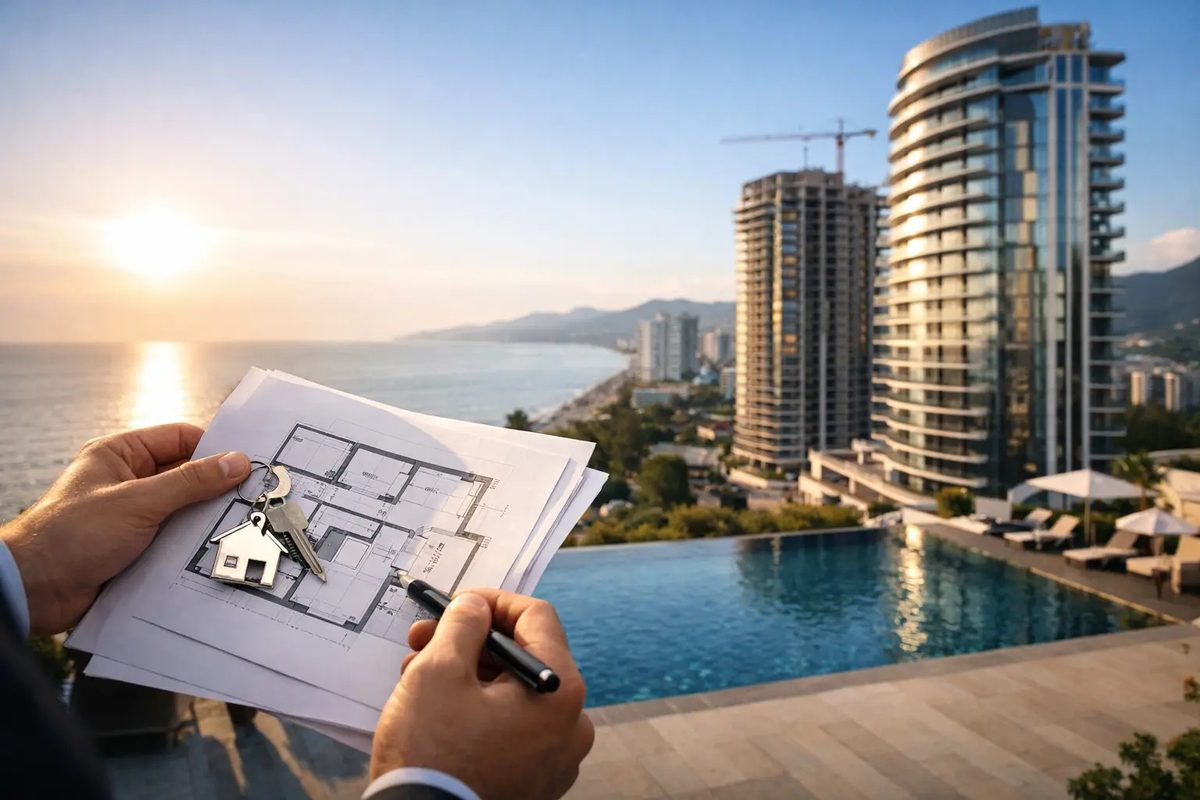
Someone who enters a good project early doesn't just buy an apartment on paper - he buys a gap. This is exactly why more investors are now looking at investing in a pre-sale in Batumi as a way to get into a lower price, before the building is completed and before the market prices the final product. But this gap is not created automatically, and it does not belong to every project. In order to turn a pre-sale into a smart deal, you need to understand what you are really buying, where the profit is, and which tests should not be skipped.
What is actually an investment in a pre-sale in Batumi?
A pre-sale is the early sale stage of a project, usually when the building is in the planning, excavation, or early stages of execution. The investor purchases a property at a starting price, sometimes under more favorable payment terms, in anticipation of appreciation as the construction, delivery, and operation progresses.
In Batumi, this model is particularly prominent around short-term rental apartments, projects in central locations, and complexes aimed at short-term rentals. The city continues to attract regional and international tourism, and the significance for the investor is clear - a property bought properly can benefit from both capital improvement and ongoing income after handover.
However, it is important to be precise: a pre-sale is not a "cheap deal" by definition. It was a deal with higher potential, but also with a higher dependence on the developer's ability to execute, the quality of the planning, the schedules, and the post-occupancy management model.
Why are Israeli investors considering pre-sale right now?
The first reason is the entry point. In a market where investors are looking for a way to gain exposure to real estate for relatively accessible amounts, Batumi offers a significantly lower entry threshold compared to many other destinations. When entering the pre-sale stage, it is sometimes possible to purchase at a lower price than the price offered in advanced stages or after delivery.
The second reason is a clear appreciation potential. If the project is located properly, properly planned, and managed properly, it makes economic sense that the property will be worth more when the building is active, furnished, and generating income. In tourism projects, value relies not only on the walls themselves but on the overall product - location, standard, operation, guest experience, and actual return.
The third reason has to do with comfort. Quite a few Israeli investors are not looking for an apartment abroad in order to start managing suppliers, cleaning units and chasing orders. They are looking for an operationalized investment. Therefore, when considering investing in a pre-sale in Batumi, it is not enough to check the floor plan. You need to understand who will manage the property the day after delivery, with what standard, and with what revenue model.
Where is the real economic advantage
The first advantage is the early purchase price. developers market in the early stages at a price that allows them to generate sales rates, prove demand, and support project financing. The investor who enters early may benefit from a price gap compared to more advanced stages.
The second advantage is the spread of payments. In some projects, the capital does not come out in its entirety in one day, but is spread out over the construction period. From an investor's point of view, this can improve liquidity and allow for more convenient financial planning. On the other hand, tiered payments don't make a good deal. They are only changing the structure of the cash flows.
The third advantage is the potential for post-delivery activation. If the property is pre-designated for the tourism market, with suitable furniture, professional maintenance, and a marketing and operations system, the transition from a "paper property" to a "income-producing property" can be faster. This is exactly where the difference between buying a unit in a building and purchasing a complete investment product is created.
Where the risk starts
Anyone who presents a pre-sale as a no-friction deal simply doesn't describe the full picture. The first risk is performance risk. a developer can delay, change specifications, or not deliver at the promised level. Therefore, the most critical check is not only what is presented in the simulation, but who is the body behind the project and what its record is.
The second risk is location risk. In Batumi, there is a fundamental difference between a property in a real tourist hotspot and a property in an area with a nice marketing promise but weaker operational demand. An apartment can be new, designed, and relatively inexpensive - and still not provide good performance in a short rental if the location does not generate stable demand.
The third risk is operational risk. Many investors focus on the purchase price and forget that current income is created only when there is professional management. Without proper pricing, maintenance, cleaning, marketing, and high-level guest exchanges, the potential for return remains on paper.
How to check if the project is really worth investing in
The examination should begin with the developer. Not in simulations or in presentations. You need to understand which projects have been completed in the past, what is the quality of delivery, whether there is compliance with deadlines, and what the actual result looks like after occupancy. In pre-sale, the developer is a key part of the security of the transaction.
Then you have to check the microlocation. Not only the city, but the street, proximity to the sea, accessibility, a tourist environment, entertainment and commercial centers, and direct competition in the area. Two projects in Batumi can look similar on paper and behave completely differently at the income level.
The next step is to analyze the rental model. Is the project suitable for a short stay? Is the planning right for the guests? Is there a furniture standard that allows for higher pricing? Is there a management company that knows how to operate the properties continuously? A good investment isn't just measured by delivery, but by subsequent performance.
It is also necessary to check the legal framework, the registration of rights, the specifications of the consideration, the terms of the contract, fines, milestones for payment, and related costs. There is no room for guidance here. A healthy deal is built on clear documents, not on verbal promises.
Investing in a pre-sale in Batumi - who is it suitable for and who is less suitable?
The deal is especially suitable for an investor who is willing to wait for the construction period to get an advantage in price and potential improvement. If the goal is to build a position in tourism real estate with a relatively accessible entry amount, and there is patience until delivery, a pre-sale can be a very correct move.
It is also suitable for those who are looking for a truly passive investment. In other words, not just purchase, but a full package of support, registration, financing coordination, furniture, ongoing management and revenue collection. In such projects, the value is not just in the asset but in the system that powers it.
On the other hand, those who are looking for immediate income from next month should understand that pre-sale is not an immediate return product. There is a waiting phase, and sometimes also uncertainty in schedules. Those who are not comfortable with the maturity period will sometimes prefer an existing property that is ready to be operated, even if at a higher price.
What is worth more than a low price
Many investors are attracted to the price first. It's natural, but it's not always the right decision point. A cheaper apartment in a weak project may be more expensive in the long run, if it suffers from low performance, poor occupancy, or problematic maintenance.
In contrast, a property in a more accurate project - with a central location, a high standard and hotel-grade management - can produce a superior result even if the entry price is slightly higher. In the world of tourism real estate, the quality of the execution directly meets the bottom line.
This is also why experienced investors don't just ask "how much does it cost per square meter". They ask what the occupancy rate is expected to be, what is the level of income per night, who operates the property, how to maintain quality over time, and what the exit strategy is in a few years.
How to approach the decision properly
The right way to examine a pre-sale is like looking at an investment, not like looking at a vacation. You need to cross-check the entry price, the payment schedule, the quality of the developer, the location, the suitability of the property for a short rental, and the actual management ability. A good deal is made when all the ingredients work together.
For an Israeli investor who wants exposure to the market in Batumi without managing the property himself, the most significant value is control of the entire chain - from locating the property to improving it, operating it and selling it in the future. This is exactly where local experience, networking, and full operation make a real difference. That's also why companies that operate in an end-to-end model, like MyBatumi, speak the language of performance and not just marketing.
The bottom line is simple: investing in a pre-sale in Batumi can be an excellent move, but only when it relies on the right project, the right data and the right management. If you choose a deal based on the quality of the execution and not just the price on paper, it is possible to create a strong foundation for future income and real improvement. The smart decision is not to enter early at all costs - but to enter early only when there is a good reason to do so.