
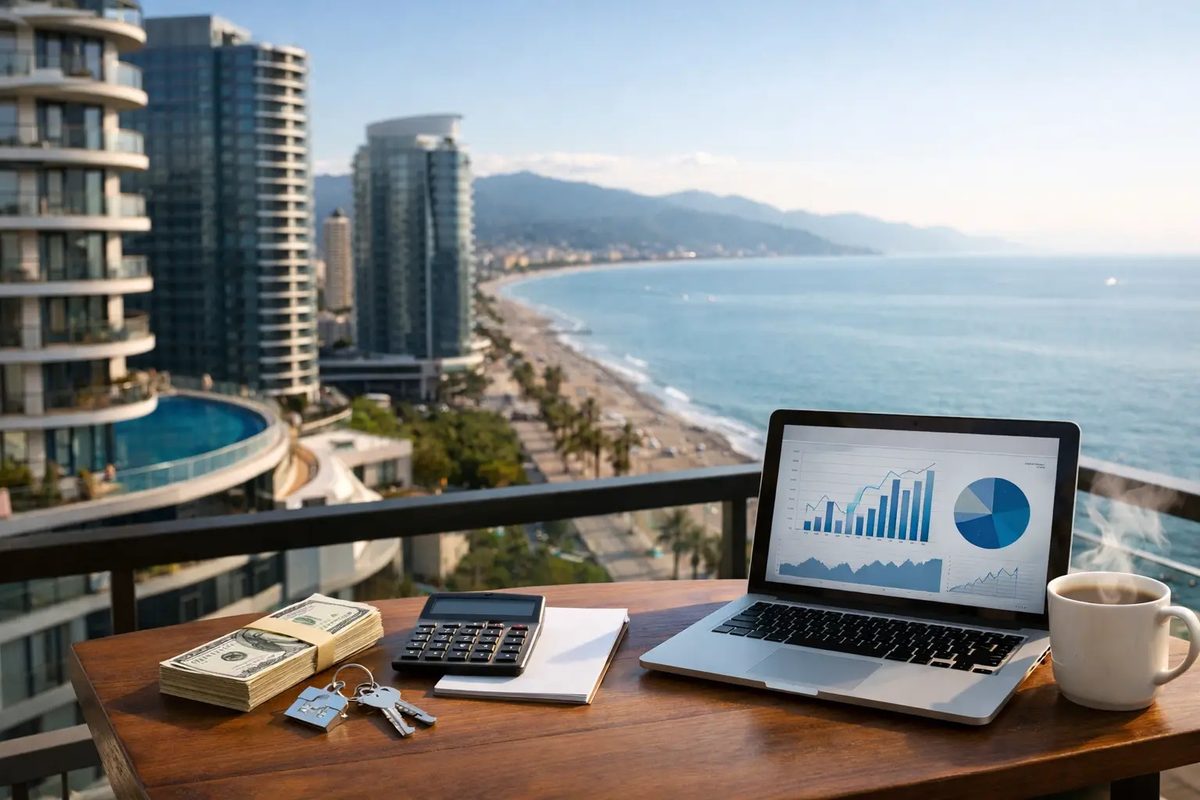
Quite a few Israeli investors are asking about passive income from apartments in Batumi after discovering the relatively low income gap compared to Israel, the tourist traffic to the city, and the possibility of purchasing a property that is designated in advance for short-term rentals. The right question, however, is not whether it is possible to generate income - but under what conditions it really becomes an investment that works over time.
In Batumi you can find apartments at entry prices that are significantly more affordable than the Israeli real estate market, but the price alone does not generate a return. True passive income rests on three clear foundations: a location that generates consistent demand, a real estate product that is suitable for the tourism market, and a management system that knows how to turn occupancy into actual income. Without all three, even a cheap property can become an asset that creates disappointment.
How is passive income structured from an apartment in Batumi
The central model in Batumi is based on short-term rentals for tourists, business people, and seasonal visitors. Unlike a classic annual rental, the potential for monthly income here can be higher, as the nightly pricing is relatively high, especially in sought-after areas and properties that are presented with a good level of finish. On the other hand, it's a model that requires more precise operation - check-in, cleaning, maintenance, guest service, dynamic pricing, and consistent marketing.
Therefore, when an investor talks about passivity, you have to be precise. The apartment itself is not passive. The professional management is what makes it such for the property owner. If there is an entity that locates the property, handles the purchase, takes care of the registration, furnishes at a level that is adapted to the tourism market, and manages the actual rental, the investor can benefit from a relatively passive model. If not, he buys himself an overseas operating business.
Why Batumi attracts investors
Batumi is not just a coastal city. It is a tourism market with strong visitor traffic, new projects, rapidly developing central areas, and relatively easy entry for a foreign investor. For Israelis, the advantage is particularly pronounced: lower entry capital, the possibility of geographic diversification outside of Israel, and the potential to combine current returns with value appreciation over time.
What strengthens the model is the fact that a significant portion of demand does not rely on a single long-term tenant, but on ongoing guest turnover. When the property is located near the beach strip, entertainment, commerce, and transportation hubs, it enjoys higher exposure to demand. Not every area in Batumi provides the same result, so the choice of street, building, and unit type is just as important as the price.
A good location is not a slogan
Many investors are attracted to the lowest price, but in a short-term rental market, a cheap property in a weak area can be left behind. An apartment in a central location, in an active tourist environment and in a building that attracts guests may cost more - but it can also maintain better occupancy, enjoy better hospitality ratings and display higher resilience during challenging times.
Simply put, you don't just buy meters. Buying demand.
What actually affects the yield
When looking at passive income from an apartment in Batumi, you need to look beyond general promises of return. The actual result is influenced by a number of variables that work together.
The first is the occupancy rate. An empty apartment, even if it is well priced, does not generate income. The second is an average price per night, which is determined by location, design, quality of furniture, seasonality, and level of competition. The third is operating expenses - management, cleaning, maintenance, marketing platforms, repairs, and ongoing burnout. The fourth is the quality of management, which affects almost every other parameter.
This is where the difference between a theoretical calculation and a real investment calculation comes in. A serious investor doesn't just look at how much you can earn in a peak summer month. It examines average annual income, seasonality, weak periods, expense rate, and the ability to maintain a standard that allows for continued demand. This is where a lot of deals that look great on paper turn out to be less attractive in reality.
High Yield vs. Stability
There are assets that promise a higher potential return, but the level of risk increases accordingly. For example, an unestablished project, a less proven location, or an overly cheap product may display enticing numbers in marketing, but struggle to produce consistent performance. On the other hand, a high-quality property in an established area can show a slightly more moderate return in the optimistic scenario, but better stability over time.
For most investors, especially those looking for passive income rather than hands-on venture, stability is just as important as maximum return.
What makes an apartment an income-generating asset
Not every apartment in Batumi is designed for short-term rentals. To generate continuous income, the property needs to be pre-selected according to commercial suitability. It starts with the size and interior design. A unit that feels comfortable, bright, functional, and well-photographed will cope better in a competitive market.
Continuing with the furnishings and the standard of hospitality. In a tourism market, the guest compares dozens of options. If the apartment looks too basic, tired or unmaintained, it will have trouble sustaining a price. On the other hand, a level of finish that feels like a quality hotel room, along with regular maintenance, can improve both occupancy and price per night.
And above all - you need a business plan. You don't buy a property and then hope for the best. Check in advance who the target audience is, what is the level of demand in the area, what is the possible price range, what are the expected expenses, and what is the investment horizon.
The real risk is not the distance - but the lack of control
Some investors are afraid of investing abroad because of the distance. This is a legitimate concern, but in practice the distance is less problematic than a lack of control over the process. If there is no entity that manages the purchase, registration, appreciation and ongoing operation, the investor is dependent on scattered local entities, without full control and without a single address that is responsible for the outcome.
On the other hand, when the investment is built as a complete model - from locating the property to managing the income - the level of certainty increases. This does not eliminate risk, because there is no risk-free investment, but it reduces operating errors, protects the quality of the property, and improves the ability to translate potential into real income.
This is exactly why experienced investors today examine not only the apartment itself, but the entire investment framework around it.
Who is this model suitable for and who is not?
The model of passive income from an apartment in Batumi is especially suitable for investors looking to enter international real estate investment for a relatively accessible amount, along with the potential for ongoing income and appreciation. It is also suitable for those who want to diversify some of their capital outside of Israel without managing renters, maintenance and reservations themselves.
On the other hand, it is less suitable for those who are looking for absolute and permanent certainty, such as bonds, or for those who are uncomfortable with the dynamics of the tourism market and seasonality. Income from short-term rentals can be very attractive, but it is not a straight line. There are stronger and fewer months, and there is a dependence on the level of management and the state of the market.
An investor who understands this in advance comes with more correct expectations - and therefore also makes better decisions.
How to examine a deal without being confused by marketing noise
The right way to check a deal is to ask simple and difficult questions. Is this a property in an area with proven demand? Is there real operating data or just an optimistic forecast? Who manages the property after the purchase? What do the ongoing costs include? What is the level of furniture and maintenance. And whether there is a reasonable exit strategy in the event of a future sale.
It's also worth checking if the model is built for a truly passive investor, or just presents itself that way. If the investor has to chase service people, handle malfunctions, or understand the local market on his own, passivity erodes very quickly.
Companies that operate in a full model, such as MyBatumi, are measured not only by the ability to sell an asset but also by the ability to sustain performance over time. For most investors, this is the difference between a transaction and an investment.
Passive income from an apartment in Batumi starts with making the right choice
Ultimately, passive income from an apartment in Batumi is neither a financial trick nor the magic of an emerging market. This is the result of choosing the right property, building a product that is suitable for short-term rentals, and professional management that knows how to work every day even when the investor is in Israel. Anyone who enters this market with serious scrutiny, realistic expectations, and a professional partner who understands both real estate and operations, can benefit from an efficient income engine within a broader investment portfolio.
Before looking only at the price or the promised return, you should ask one simple question: Who will really make sure that the apartment will work for you in two, three and five years?